
© X Filme Creative Pool GmbH
There is a cruel irony at the center of Isabelle Stever and Anna Melikova’s newest film: just as co-protagonist Oleh begins to embrace his masculinity on his own terms, war arrives to prescribe him what being a man is supposed to mean. For Oleh (Markus Bright), a transgender man living in Ukraine with his girlfriend Olya (Tania Myronyshena), transition opens one future while Russia’s invasion violently closes another. Borders, military service, family expectations and even language begin attaching new restrictions and obligations to identities that had seemed possible to navigate by oneself.
Director: Isabelle Stever
Year: 2026
Country: Germany, Ukraine
Runtime: 100 minutes
The film makes this contradiction apparent almost immediately. I Rarely Wake Up Dreaming begins with a relationship argument that keeps expanding through dialogue and sound. From afar we witness a couple argue behind closed see-through curtains. Olya tells Oleh that this is not the relationship she thought she had entered. “You promised you’d stay the same person,” she says; to which Oleh responds “Olya, I am the same person.” Then the conversation turns to military service. She threatens to break his legs so he will be declared unfit. An air-raid siren sounds. In only a few minutes, gender, queer desire, resentment, conscription and war have collapsed into a single domestic space.
It is an extraordinarily economical opening, not because it explains everything, but because nearly every tension the film will later complicate is already sitting there in the room. Isabelle Stever and Anna Melikova examine this collision between self-definition and the wider circumstances in which this process takes place. Though directed by Stever, the film is credited as “a film by Isabelle Stever & Anna Melikova,” foregrounding a creative partnership that began with Stever’s previous feature, Grand Jeté, the transgressive, precisely controlled Freudian drama they also co-wrote.
From there, utilizing the film’s highly elliptical and occasionally non-linear structure, Stever and Melikova move us back to New Year’s Eve 2021, when catastrophe remains a distant but ominous premonition. Olya dreams of walking through a graveyard where years, rather than people, are buried, an image given a vivid immersion by Stever and cinematographer Volodymyr Usik. In waking life, however, there is still room for lightness. Olya and Oleh go to a queer party filled with neon, affection and community, less than two months before the full-scale invasion.
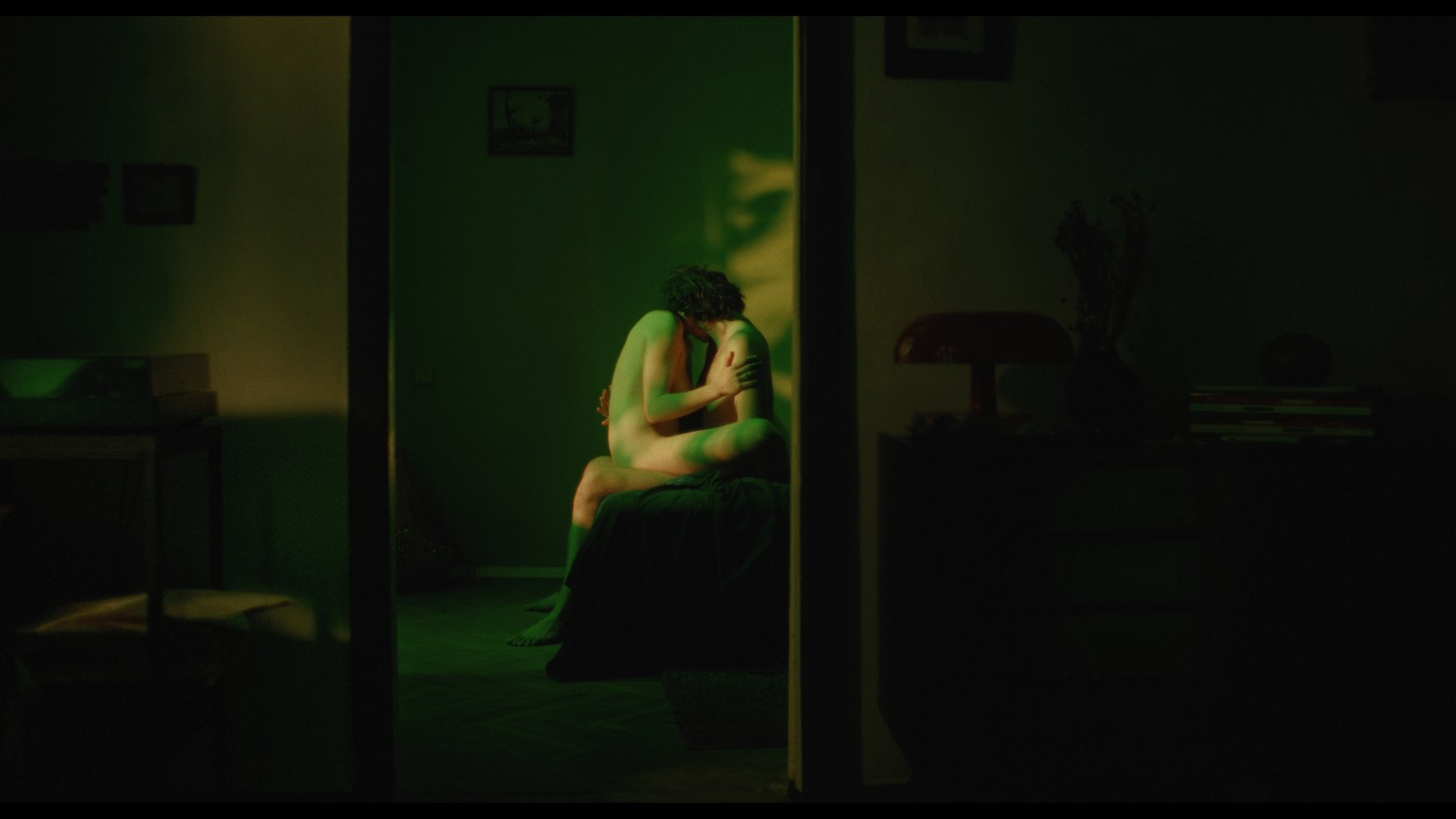
That tenderness extends to one of the film’s most beautiful scenes, in which Olya and Oleh have sex behind the frame of a doorway. Stever keeps just enough distance for the moment not to feel intrusive, while alternating red and green light catches their bodies as they kiss and caress one another. Their hopes are similarly intimate: they want to go to the sea, to Crimea, where Oleh imagines going bare-chested for the first time.
Then catastrophe arrives in the form of literal bangs. Oleh wakes Olya after hearing explosions, and they flee Kyiv, eventually planning to move to Germany. At the border, however, his transition becomes a bureaucratic trap. Recognized as a man, he is subject to wartime restrictions; recognized as trans, he is met with suspicion and humiliation. A border guard reduces the contradiction to a taunt: if he wants to be a man, he should defend his country and his wife.
Everything appears to happen at once while time itself remains suspended. Questions of who must fight, which language may still be spoken, whether Oleh can leave, whether he can safely inhabit masculinity and how much of himself he can reveal to Olya’s family all begin to overlap. Olya’s mother speaks innocently about grandchildren, unaware that Oleh is trans, while more and more people pressure him toward the front.
Myronyshena and Bright, both first-time queer actors, give remarkably natural performances that keep these conflicts from ever feeling constructed. I Rarely Wake Up Dreaming is strongest when it observes how war hardens categories that private life had made fluid.
I Rarely Wake Up Dreaming premiered at the 2026 Locarno Film Festival as part of the festival’s International Competition.

