
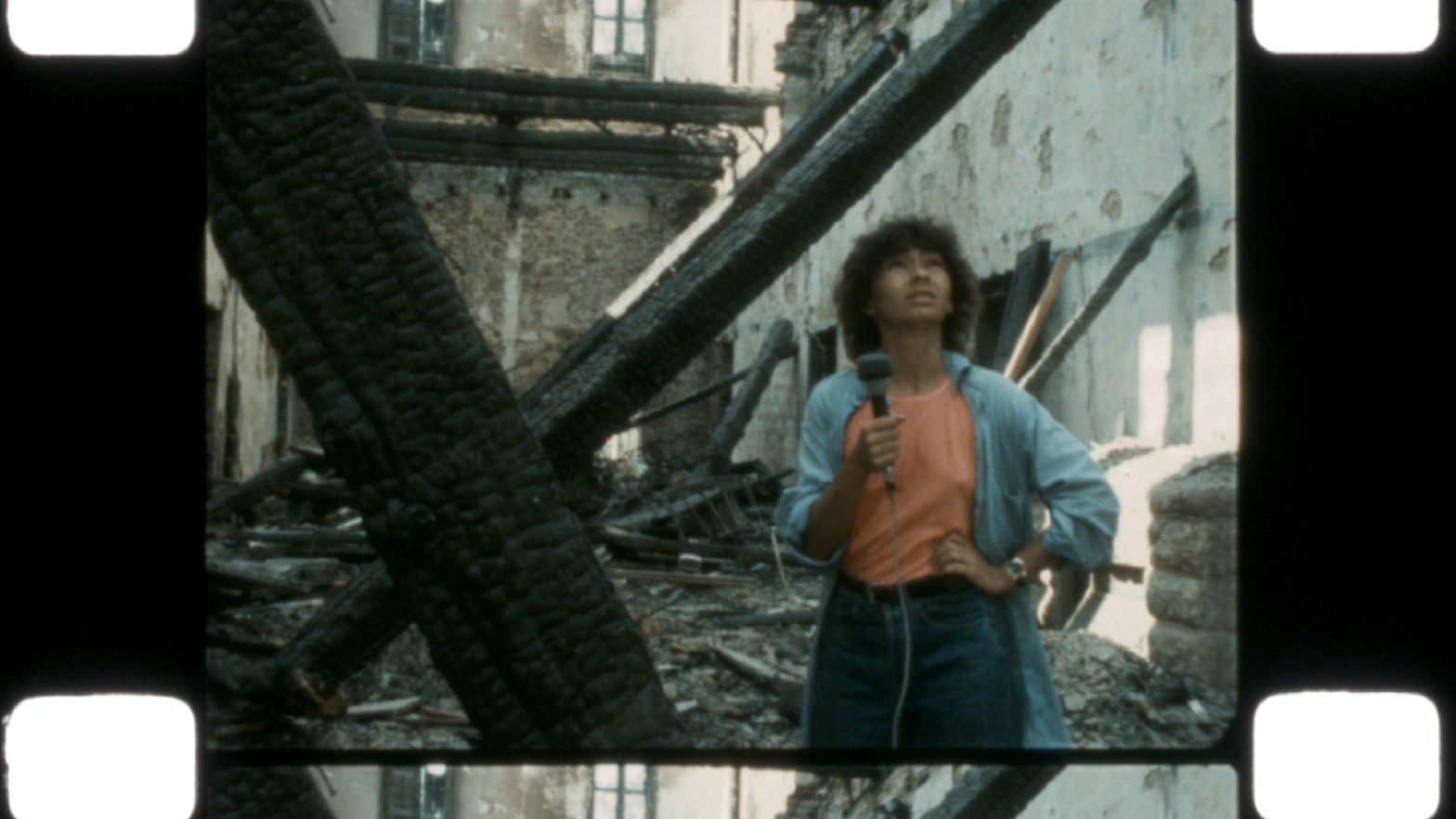
Renowned Palestinian documentarian and archival researcher Mohanad Yaqubi’s newest documentary, Revolutionaries Never Die, finds its roots in an unanswered message. In 2018, Lebanese filmmaker Jocelyne Saab contacted Yaqubi about collaborating on a project. She died three months later, before he replied. Years afterward, working through 113 reels of Saab’s 16mm films, Yaqubi constructs the response he never sent. The result is a tribute to the revolutionary Lebanese filmmaker, her filmmaking, and a meditation on what it means to inherit another person’s images.
Director: Mohanad Yaqubi
Year: 2026
Country: Palestine, Belgium, Qatar
Runtime: 81 minutes
Rather than simply presenting Saab’s work retrospectively, Yaqubi places it in conversation with the present. Her films move through Palestine, Lebanon, Egypt, Iran and Western Sahara, documenting war, revolution, exile and anticolonial struggle. Yet these images never feel confined to history. Watched by audiences today, scenes of displacement, destroyed homes and political violence appear disturbingly familiar. Yaqubi’s film is haunted by the sense that the past has not passed at all.
This makes the materiality of the archive especially important. Yaqubi repeatedly shows reels, film strips and boxes, reminding us that these images have physically survived the events they document. Yaqubi explicitly makes it clear that the archive is not a static collection to be protected from time, but something that must be handled and reactivated. Presenting his own vision through on-screen text and editing, alongside Saab’s images, Yaqubi creates a dialogue with Saab that could not happen while she was alive.
He is also interested in Saab’s position behind the camera. She films Palestinian fighters, Lebanese civilians and revolutionary movements from a position of solidarity, while remaining attentive to the ordinary desires that exist within political struggle. Whereas most films on the subject are predominantly concerned with death and sacrifice, through his editing Yaqubi highlights the amount of love, intimacy and the possibility of another kind of life was present in Saab’s work.
The connection between Saab and Yaqubi is most palpably presented when their histories begin to visually overlap. Saab filmed the destruction of her home in Beirut; decades later, Yaqubi’s own home in Gaza was destroyed, both by zionist forces. The parallel gives the film its emotional weight but also raises the question of whether filmmakers have been recording the same forms of violence for generations, what can images actually change?
Revolutionaries Never Die argues for the archive as a form of ongoing dialogue. Images may not prevent history from repeating itself, but they can preserve connections between struggles, generations and places that might otherwise be separated or forgotten. Yaqubi’s film turns his delayed response to Saab into a reflection on cinematic inheritance and on the responsibility of returning old images to the political present. The archive becomes valuable through its ability to let history speak and create a dialogue between past and present.
Revolutionaries Never Die premiered at the 2026 Locarno Film Festival as part of the festival’s Filmmakers of the Present Competition, where it won the Special Jury Prize.

