
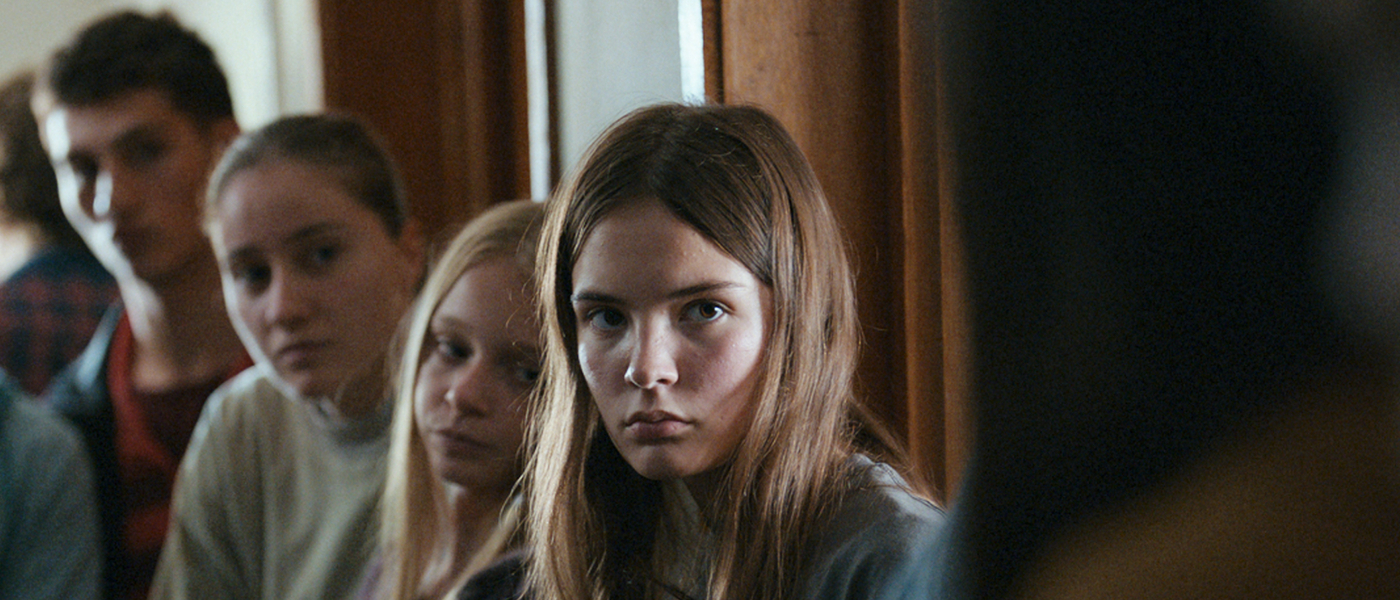
Blerta Basholli’s follow-up to her 2021 Sundance winner Hive, Dua, delivers a portrait of a teenage girl’s daily routine disrupted by the increasing marginalisation she experiences during the Kosovo War. The film is set in late 1990s Prishtina, where Kosovar Albanian families live under systemic violence and the constant threat of exile. Dua (Pinea Matoshi), thirteen, wants the ordinary freedoms of early adolescence. She wants to belong at school, to understand her changing body and to move through her city without fear.
Directed by: Blerta Basholli
Year: 2026
Country: Kosovo, Switzerland, France
Length: 101 minutes
Following an opening with the familiar beats of the usual coming-of-age drama, the film intensifies from its practical view of fear, shaped by the political. The initially meek Dua, alongside a group of girls her age, styles her hair and puts on makeup make-up before attending a party where she hopes to receive her first kiss from a boy. Whereas the start of the film makes us believe that Dua’s biggest worries are rooted in navigating puberty as a girl, this development is quite literally broken up by the arrival of Serbian police, marking the start of new challenges. The simple coming-of-age narrative is replaced by the bleak reality of ethnic oppression. Gradually, Dua’s classmates leave school as their families flee the area. Violence increases in the streets, until Dua stumbles upon the dead body of a classmate’s relative. Refugees arrive with news from towns already hit by war. At home, Dua’s parents measure each decision against the danger it could bring. Police attention, regardless of cause, can lead to arrest, disappearance or death, especially for the men in the household. Survival means staying quiet, avoiding confrontation and accepting rules imposed by people who control the streets while waiting for the possibility of escape.
Dua resists this idea of survival. After surviving an act of violence herself, her anger turns toward revenge. Maki, a new classmate from the warzone, gives that anger a physical outlet by encouraging her to attend judo classes, making Dua discover power in her own body and offering her the idea that she might be able to stand up against those who have wronged her and her people. Yet, while judo can make Dua physically stronger, it cannot balance a fight against a political system built to systemically punish resistance.
As Dua, Pinea Matoshi delivers a strong performance of a character stuck somewhere between courageous stubbornness and powerlessness, old enough to understand danger, yet young enough to misjudge consequence and the larger situation around her. Throughout the film, her expression shifts from curious, to intense, to vulnerable – all perfectly conveyed through Matoshi’s gazes and amplified by a camera that closely tracks her presence and movement throughout.
Dua wants to stay and strike back, while her brother dreams of joining the armed resistance against the Serbs. Their parents, terrified that bravery will turn into a death sentence, push for silence and escape. Basholli gives no moral judgement to Dua’s fury. Her anger is righteous, born from humiliation and the need to protect herself and her people. The tragedy lies in the scale of what she faces. One girl cannot stand alone against the growing oppressive presence closing in around her. Dua leaves us with the imbalance of a child who is rapidly forced to grow up and stand up for herself, only to find that even real courage can be cruelly outmatched.
Dua premiered at the 2026 Cannes Film Festival as part of the festival’s International Critics’ Week section.
 obviouslyreviews.com