
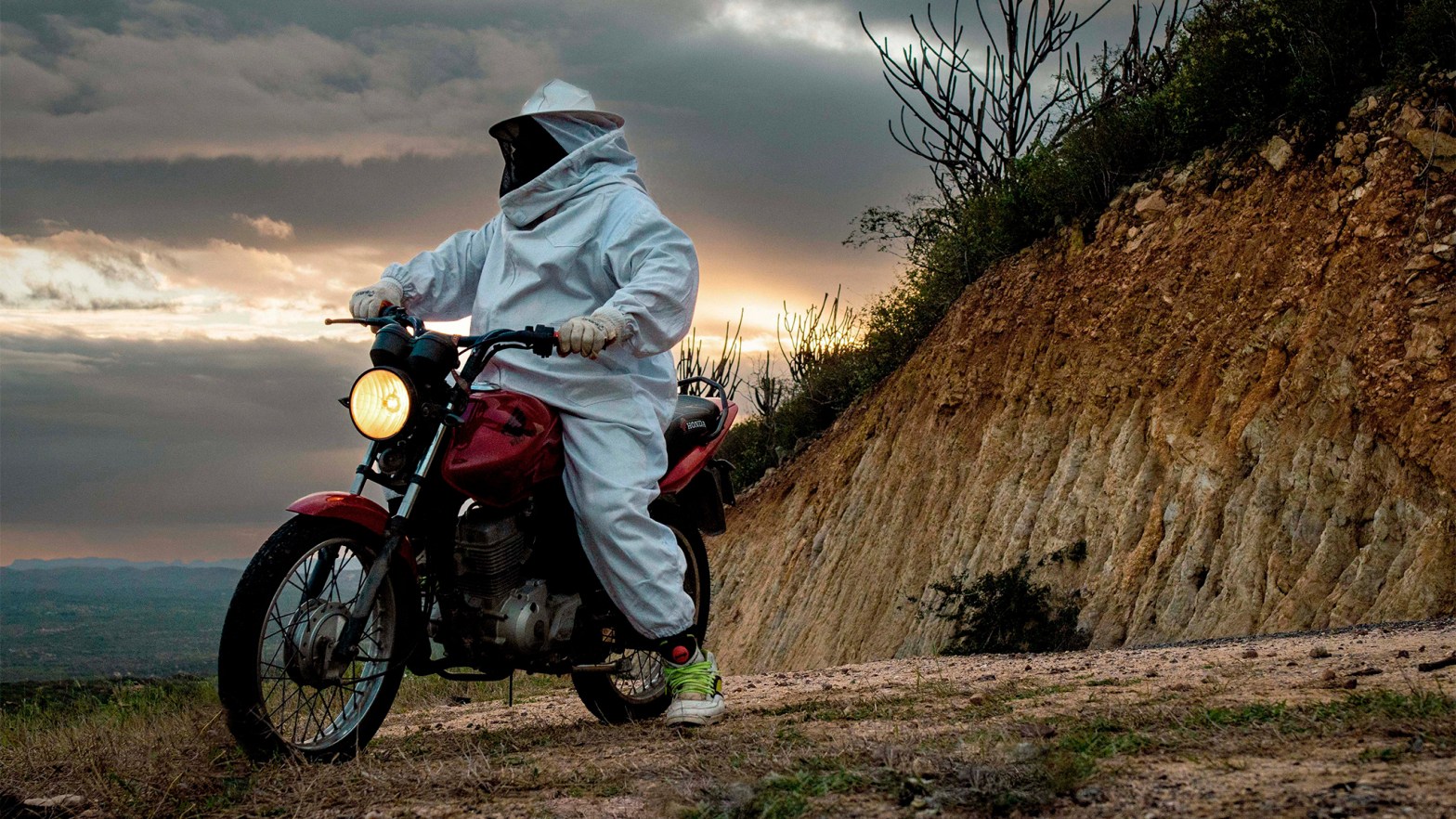
© Gilvan Barreto
Yellow Cake is a bold yet uneven sophomore feature from Brazilian writer-director Tiago Melo, in which he blends eco-sci-fi, political satire and B-movie tropes. The film trakes place in the town of Picui, Brazil, rich with uranium, where a government-supported initiative promises to eradicate dengue fever by sterilising mosquitoes through ‘controlled’ radiation.
Directed by: Tiago Melo
Year: 2026
Country: Brazil
Length: 97 minutes
Starring in the lead is Rejane Faria, delivering a controlled and commanding performance as nuclear physicist Rúbia Ribeiro. Rúbia provides a link between the state, foreign researchers, and the local workers whose land is being mined. Faria provides an otherwise-chaotic film with its most grounded element. Her restraint as Rúbia, including convincing moments of constant hesitation and frustration, gives the character dimension, as she’s increasingly aware that she may be complicit in something disastrous.
Also starring in a small but memorable supporting role is veteran actress Tania Maria, who managed to capture the hearts of many in last year’s The Secret Agent by Kleber Mendonça Filho. Maria plays Dona Rita, a local voice of reason and resistance who warns of the risks and uranium’s militarisation potential. Her performance is warm, expressive, and provides some of the film’s best moments. Her character embodies the lived memory of exploitation in the area, reminding us that uranium in Brazil is tied to real historical trauma, echoing the 1987 Goiânia accident in Goiás, and providing a necessary and timely history lesson amidst increased Western imperialism in Latin America.
Melo’s satire is intentionally broad. As dengue cases surge into the United States and Europe, suddenly turning a “regional” issue into a global emergency, the director paints a blunt and much-needed critique of imperialism in the Global South. Meanwhile, miners trade uranium stones without fully understanding what they are handling. One worker stores it at home; a baby is born sick. If the army seals the mines, they lose their livelihood. Where there’s uranium, there’s gold but also quite evidently precarity.
The film’s final, and longest act, the aftermath of the proceeding of testing despite warnings, is pure pulpy genre delirium. It’s chaotic, trashy, and recalls B-horror movies with its body horror amidst nuclear armageddon. The tonal shift happens rather abruptly and exposition tends to overwhelm the tension that was present earlier in the film, making room for visual spectacle instead of continuing its socio-political critique.
What Yellow Cake ultimately does well is fuse the absurd spectacle with genuine and aware anger. The film’s excess of pulp may distract in the latter half, but beyond that is a pointed indictment of extractivism and the fantasy that technology can fix crises that are created by those who created it. While not perfectly calibrated, Melo’s work is provocative and thought-provoking
Yellow Cake premiered at the 2026 International Film Festival Rotterdam (IFFR) as part of the festival’s main Tiger Competition.
 obviouslyreviews.com