
© Family Affair Films, Junafilm, SWR/ARTE
Dutch director Rosanne Pel’s sophomore feature Donkey Days, a Dutch-German co-production filmed in Germany with a predominantly German cast, is an intense and ambitious film that examines the tensions within an all-female family of three, using both realism and surreal elements. It examines the power dynamics between two adult sisters and their mother, demonstrating how conditional affection and criticism can define relationships over a lifetime. Pel balances a detailed depiction of domestic conflict with a confident and unique style, resulting in an upredictable, intense, and occasionally funny work.
Directed by: Rosanne Pel
Year: 2025
Country: Netherlands, Germany
Length: 108 minutes
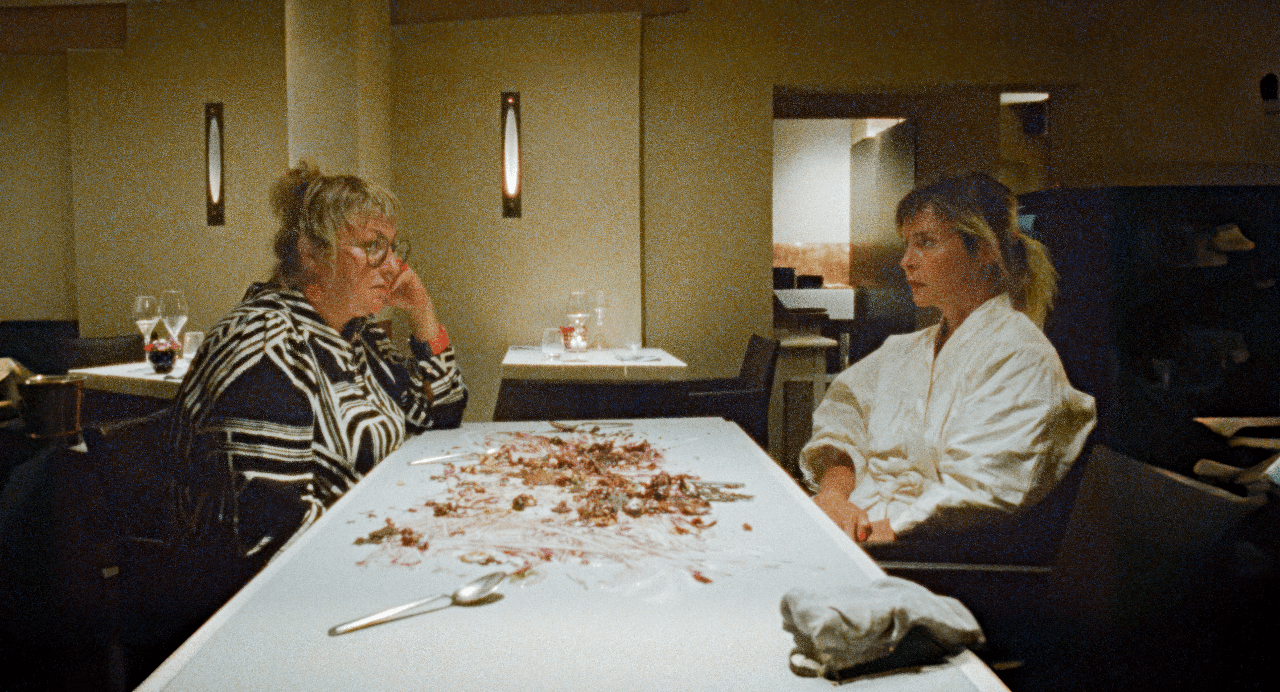
The film begins with Anna (Jil Kramer) at a restaurant table with her sister Charlotte (Susanne Wolf) and their mother Ines (Hildegard Schmahl). Anna’s girlfriend Noe (Amke Wegner) is present for what initially appears to be an festive family dinner. The conversation quickly reveals underlying tensions. Charlotte questions Noe’s work in a café in a way that carries a tone of judgment. Anna responds with defensiveness. When Anna mentions her plans to travel to Sweden, Ines dismisses them and asserts that the family will go to France instead. The scene is brief but establishes the power dynamics and its consequences early on, demonstrating the hierarchy and lack of mutual respect that characterizes the family dynamic.
Pel builds pressure formally through rapid editing, handheld camerawork, close-up framing, and a tense score of percussion and piano. She avoids explaining the source of the family’s fractured relationships from the get-go, allowing the audience to gather information gradually. Over time, it becomes clear that Anna is impulsive, emotional, and connected liberal queer circles. In contrast, Charlotte is disciplined, cold, conventional, and focused on stability. Their differences feed a competition for their mother’s approval, which is given sparingly.
Pel makes many interesting stylistic decisions. One sequence uses a slow camera rotation around the family home to subtly shift its presentation from welcoming to unsettling. Another shows Anna and Noe swimming, filmed in a way that fragments and refracts the image into something abstract and visually beautiful. Surreal elements appear throughout the film: a portrait in Ines’ home changes facial expressions, A young Ines (Carla Juri) appears and interacts with present-day Anna and Charlotte. The inclusion of many subplots and metaphors causes some to be introduced and then abandoned. The titular donkey subplot, in which Ines has sent monthly payments to a Hungarian donkey farm for a decade, is left rather unresolved. Additionally, an uncle who is reported dead by Ines and is given a memorial reappears later without explanation.
The film’s narrative may wobble, but its thematic core is sharp. Pel shows how parental authority shapes, and warps, these women’s relationships and personalities. Ines’s criticisms are at times devastating; She makes remarks about Anna’s weight, used by Charlotte to alienate her sister from her mother. Anna retaliates by making observations about Charlotte’s appearance, her biggest insecurity. The sisters use their mother’s criticisms as tools against one another, continuing cycles of judgment and comparison.
Donkey Days is uneven in its pacing and sometimes loses direction in its more unconventional detours. However, it succeeds in presenting a thought-provoking portrait of a family defined by rivalry, conditional affection, and unspoken grievances. The performances are consistently strong, and Pel’s willingness to pursue unconventional narrative and visual choices gives the film a distinctive identity.
Donkey Days premiered at the 2025 Locarno Film Festival as part of the festival´s International Competition.
 obviouslyreviews.com