
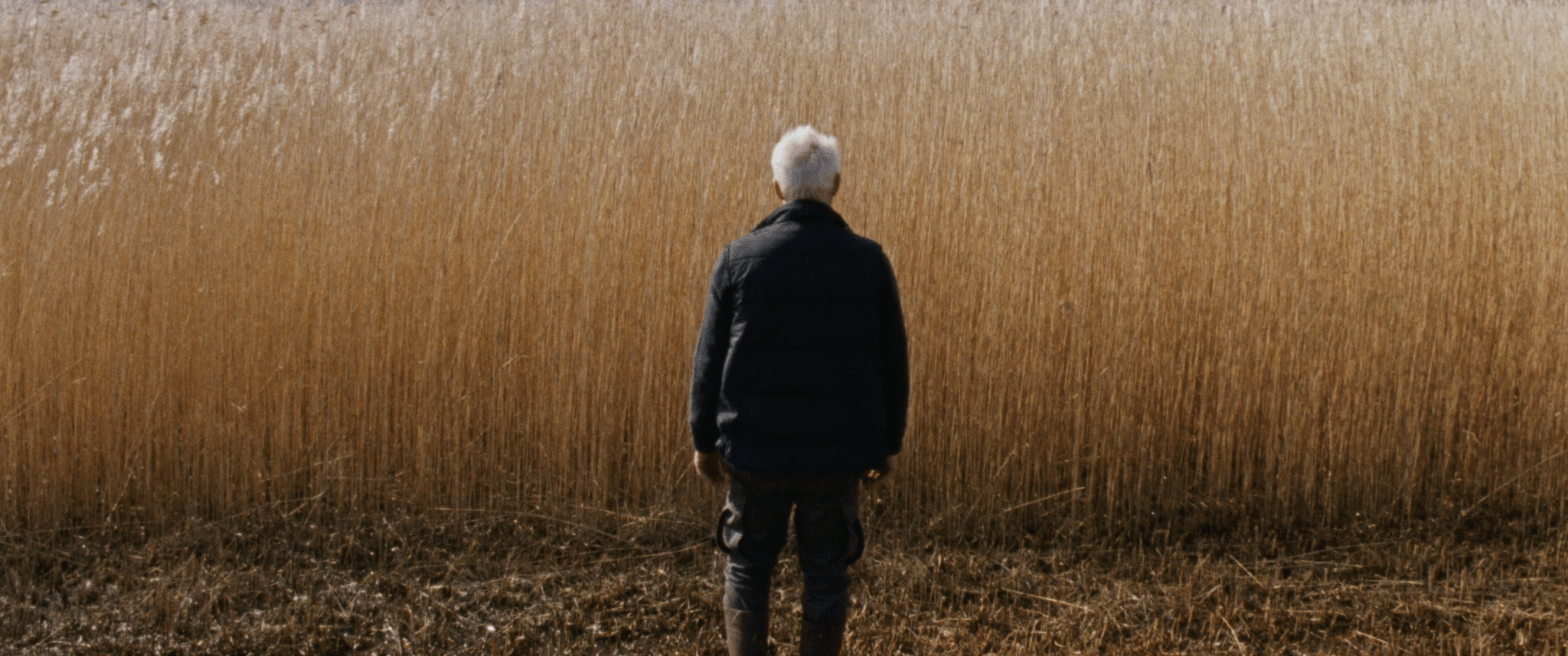
© Viking Film
Reedland by Sven Bresser depicts contemporary rural Dutch life, where daily farming rituals collide with global pressures, family bonds, resulting in moral unease. Through striking imagery and evocative sound design, the film explores how tradition, isolation, and disruption shape the life of a solitary farmer in the reed fields.
Original Title: Rietland
Directed by: Sven Bresser
Year: 2025
Country: Netherlands, Belgium
Length: 105 minutes
The film begins in darkness, with the metallic rumble of machinery, almost alien-like filling the air. When the image finally appears, it reveals reeds swaying in the wind, birds circling above, water lapping against the land, accompanied by natural sounds. This quiet rhythm soon faces intrusion: the roar of planes, the crack of fire, the harsh cry of machines. Bresser orchestrates sound with precision, so that every creak unsettles the fragile balance of the landscape.
At the center of the narrative is Johan (Gerrit Knobbe), a reed cutter whose life follows a ritual of work and silence. He cuts reeds by hand, burns brush, tends to animals, and returns to a home lined with family photographs. His solitude only breaks when his daughter Aaf and her child visit, bringing tenderness that briefly softens his stern exterior. These moments of warmth contrast with the weight of isolation that defines him.
The narrative takes a darker turn when Johan stumbles across a young girl’s body hidden in the grass. Her pale skin, her lifeless stillness, and the insects already claiming her form mark a rupture in the natural order. Rumors flare, suspicion falls on outsiders from a neighboring village, and old resentments resurface. The community’s fear of the “other” spills into open hostility, echoing currents of xenophobia present in Dutch society today. Yet Johan begins to suspect that the violence may have come from within his own community. He is left torn between loyalty to his peers and the demand for justice, a choice that deepens his inner conflict.
This dilemma runs in parallel with another thread. Johan discovers a tar-like substance in his soil that clings to his skin like a mark of guilt. It suggests pollution, a spreading contamination that mirrors the debate around nitrogen emissions known in the Netherlands as the nitrogen crisis, which has placed enormous strain on farmers in recent years. His neighbors rage against strict regulations and imagine revolt as the only path to survival. Johan hesitates. He shares their fear of collapse, yet senses that resisting regulation may cause even greater harm.
What makes Reedland so compelling is its authenticity. Dialogue is delivered in raw local dialect by farmers and non-professional actors, people whose own lives echo through the script. Their voices carry the bluntness of real conversations. This naturalism grounds the story in lived experience, giving it an urgency that goes beyond fiction.
The themes at play root the film in today’s Dutch politics: femicide, environmental collapse, fear of outsiders. Johan’s moral struggle reflects the way entire communities now wrestle with questions of survival responsibility in amidst internal violence and global pressures.
With Reedland, Bresser delivers a multi-layered portrait of contemporary life for farmers and villagers in the Dutch countryside. The film brings together multiple voices and perspectives, showing how individual struggles reflect broader political and environmental debates. By following Johan’s uncertain path, the viewer is encouraged to look beyond familiar positions, to acknowledge conflicting truths, and to imagine a more sustainable future.
Reedland premiered at the 2025 Cannes Film Festival as part of the festival’s International Critics’ Week section.
 obviouslyreviews.com