
© Afterschool Production
Lithuanian filmmaker Laurynas Bareiša’s sophomore feature “Drowning Dry” is a unique portrayal of masculinity and its consequences, solidifying the director’s reputation as a true auteur. Following his 2021 success with Venice Orizzonti winner “Pilgrims“, Bareiša already manages to surpass himself with his subtle yet precise exploration of fate, gender dynamics, and the influence of toxic masculinity.
Director: Laurynas Bareiša
Year: 2024
Country: Lithuania, Latvia
Original Title: Sesės
Runtime: 88 minutes
The film’s narrative centers Ernesta, her MMA fighter husband Lukas, their son Kristupas, and her sister Justė’s family during a weekend at a country house. What begins as a tense yet ordinary family vacation quickly spirals into a tragedy, leaving the sisters to navigate life as single mothers. From the start, “Drowning Dry” grips the viewer with a tangible sense of dread, established during an early kickboxing match where Lukas’s victory is met with Ernesta’s unease and sadness rather than joy. This scene sets the tone for the film, framing the story through the lens of toxic masculinity, a theme Bareiša dissects with precision throughout the film.
The film’s pacing is deliberately slow, with an unsentimental tone, devoid of a score and dramatic emotionally manipulative devices, allowing for a close and objective examination of the characters’ interactions and relations. Long takes and static shots emphasize the tension simmering beneath the surface. In an early scene, Ernesta’s attempt to comfort Lukas is met with cold rejection, only for him to reassert his dominance later through physical means. Such moments of subtle, unspoken conflict are emblematic of Bareiša’s focus on the corrosive effects of hypermasculinity.
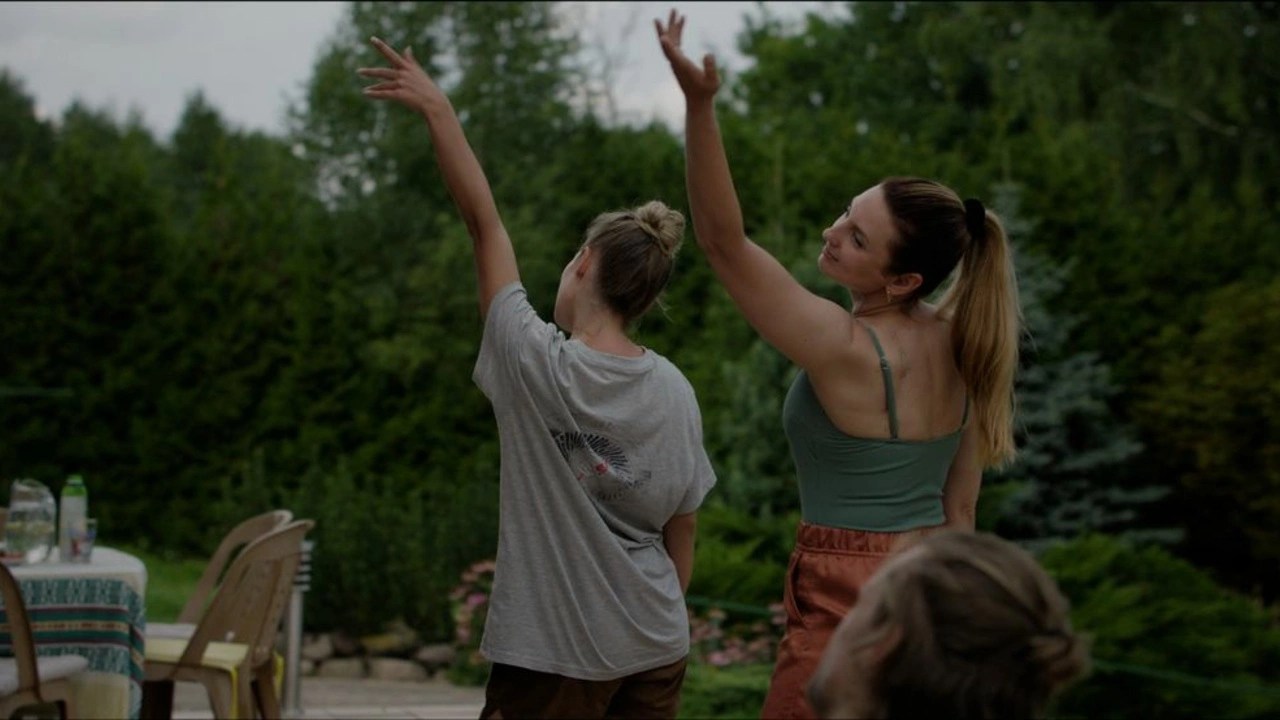
A strong contrast is drawn between the men’s aggressive posturing, entangled in an almost-primal competition to prove their masculinity, and the women’s quieter moments of connection. In one sequence, Ernesta and Justė engage in a synchronized dance to Donna Lewis’s “I Love You Always Forever,” a scene rich with harmony and warmth. The shift in tone, as well as the choice of music, highlights the film’s exploration of gender roles and the stark differences in how masculinity and femininity are portrayed.
Bareiša takes a bold narrative risk halfway through the film by abandoning a linear structure. The story jumps forward in time, then repeats a scene we’ve seen before, but with a slight twist—a different song playing during the dance, leading to different subsequent events. This structural choice adds a layer of subtlety, perfectly aligning with the film’s overall atmosphere while emphasizing the cyclical nature of trauma and memory. This fragmented approach may be disorienting, but skillfully conveys the instability that plagues the characters’ lives.
The film’s visual style also plays a crucial role in amplifying its themes. Bareiša utilizes subtle camera zooms and a voyeuristic perspective to heighten the sense of dread. Even in moments of calm, there is an underlying tension, reinforced by the recurring imagery of violence, masculinity and the way it is shown to be inherented by and influencing our next-of-kin, with children repeating their parents’curse words, glimpses of outbursts, and a violent video game blaring in the background of a child’s bedroom. These elements serve as quiet but ominous reminders of the toxic masculinity and gender performativity that permeates every aspect of the characters’ lives, hinting at how deeply ingrained it is within societal structures.
“Drowning Dry” is a study in binary contrasts: between men and women, strength and vulnerability, connection and isolation. It is a film that refuses to offer easy resolutions, instead leaving viewers to grapple with the discomfort it so expertly evokes. Bareiša has crafted a haunting and unsettling narrative that encourages the viewer to reflect on its real-life implications.
“Drowning Dry” premiered at the 2024 Locarno Film Festival, where Laurynas Bareiša won the Leopard for Best Direction and Gelminė Glemžaitė, Agnė Kaktaitė, Giedrius Kiela, Paulius Markevičius won a shared award for their performance in the film.
 obviouslyreviews.com