
IFFR
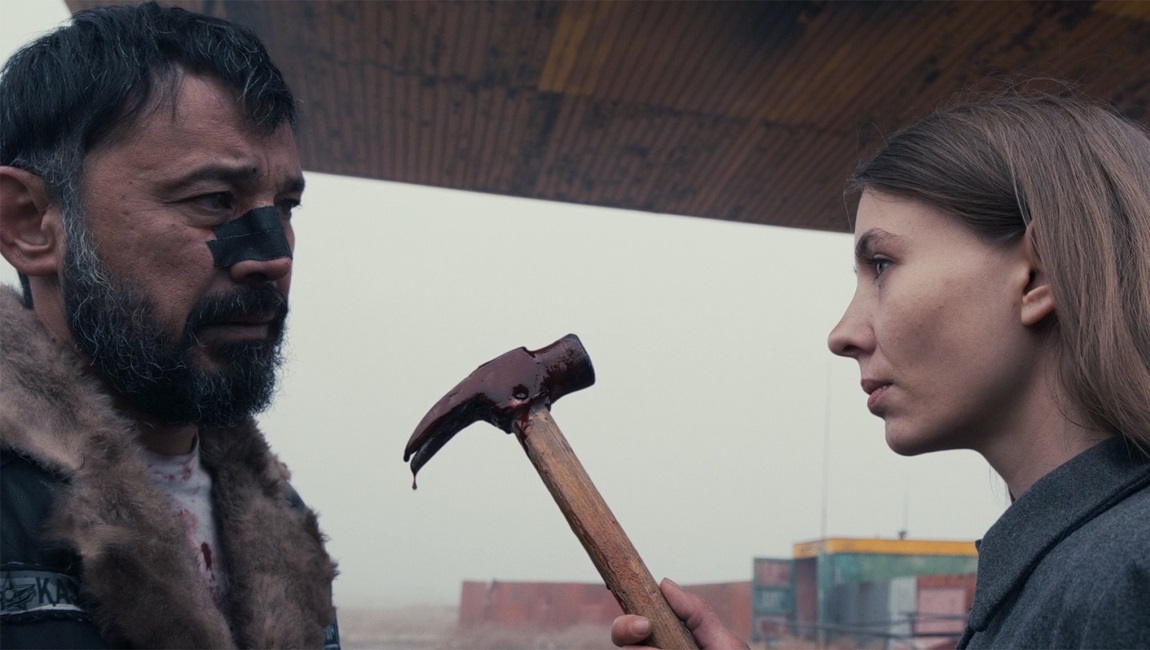
Adilkhan Yerzhanov’s latest film, “Steppenwolf,” is an exploration of trauma, violence, and masculinity, presented through the story of a mother looking for her missing child. Set against the backdrop of a violence-ridden small town engulfed in riots, the film follows Tamara, a traumatized woman in a nearly catatonic state of dissociation, as she searches for her son, Timka. Tamara’s desperation leads her to enlist the help of a brutal criminal-turned-investigator, offering him a reward to bring her child back. This unlikely partnership sets the stage for a fascinating journey through a landscape of despair and brutality.
Directed by: Adilkhan Yerzhanov
Year: 2024
Country: Kazakhstan
Length: 102 minutes
Yerzhanov’s film is a unique blend of diverse inspirations, expertly interwoven to preserve his own style. While the homage to John Ford’s “The Searchers” signals a reverence for classic cinema within the first few minutes, “Steppenwolf” broadens its intertextual reach by incorporating structural elements reminiscent of Samurai films, alongside direct references to the film’s eponymous source novel by Herman Hesse through on-screen quotes. This blend of influences serves as a rich backdrop for Yerzhanov’s signature style, which is ever-present, and characterized by a mixture of crime, bleak violence, and dark humor. In “Steppenwolf,” these elements coalesce more effectively than in any of his previous works, striking a balance that enhances the narrative’s intensity while at the same time offering the viewer several moments to breathe.
Tamara’s (Anna Starchenko) journey is defined not only by the physical absence of her son but also by the pervasive ableism and misogyny she encounters from the predominantly male figures surrounding her wherever she goes. This toxic environment, where every interaction is tinged with condescension and mockery, highlights the systemic issues of toxic masculinity that plague the society depicted in the film. Brayuk (Berik Aitzhanov), the titular Steppenwolf, a sadistic investigator embodying these traits, initially appears as the antithesis of empathy and compassion. Yet, as his character develops a bond with Tamara and engages with his relatives, Aithanov’s performance reveals layers of complexity that suggest a small sliver of humanity beneath the surface. This portrayal, juxtaposed with Mendygozhina’s quiet and touchingly resilient Tamara, illustrates a dynamic evolution of characters who transcend their initial archetypes.
The visual storytelling in “Steppenwolf” is equally compelling, with Yerzhanov’s direction bringing the novel’s themes to life against the backdrop of the actual Kazakh steppe. The cinematography is stunning, marked by long shots of misty landscapes, meticulous lighting, and especially the color grading, all of which contribute to the film’s atmospheric depth.
Yerzhanov’s “Steppenwolf” is a significant milestone in the director’s career, offering an arresting dive into the societal and personal impacts of violence, trauma, and masculinity. With unique characters, settings, and his trademark style, Yerzhanov creates an impactful experience for his audience. At only 41 years old, with “Steppenwolf” being his fifteenth feature in twelve years, the director has established himself as a prolific filmmaker. His ability to meld diverse influences while maintaining a unique voice is a rare talent. With the director improving with each film he makes, one can only expect even more intriguing works in the future.
“Steppenwolf” premiered at the 2024 International Film Festival Rotterdam as part of the festival’s Big Screen Competition.
 obviouslyreviews.com