
© Swallow Wings Films
“Snow in Midsummer” by Keat Aun Chong is a deeply affecting film that delves into an underrepresented piece of history. Inspired by true events and literary sources, the film weaves a tragic narrative around the 1969 racial riots in Kuala Lumpur, Malaysia, also known as The 13 May Incident. The film plays at the intersection of art and history, serving as both an emotional journey and an unsettling social commentary, shedding light on an often underexplored and oftentimes misrepresented part of Malaysian history.
Directed by: Keat Aun Chong
Original Title: Wu Yu Xue
Year: 2023
Country: Malaysia, Taiwan, Singapore
Length: 116 minutes
The film employs a two-part structure. The first half delves into the events that happened on 13 May 1969, swinging between two main characters: Here, we meet Dou E, a troupe master grappling with bureaucratic hurdles as she prepares to perform a Cantonese street opera, ‘Snow in June.’ Her lack of a blue citizen card and the pushy demands of officials for her performance permit are touched upon by the filmmaker early on. Parallelly, we meet Ah Eng, a young girl whose distress at school becomes a haunting microcosm of the racial tensions between people of Chinese and Malay descent in the area. “It will pass,” her mother assures her after asking if her daughter was bullied by her Malay classmates, a line that carries the weight of unresolved strife and sets the tone for an impending calamity. These two characters are well-crafted to represent the broader Chinese community in Malaysia at the time.
Adding layers of complexity are cultural-historical elements like the surreal appearance of Tun Sri Lanang slowly walking through the city on an elephant, who proclaims, “The royal line will never bow to you in mutual respect and love.” Here, the director profoundly conveys a historical sentiment of resistance against the idea of Malay royalty coexisting or integrating with Chinese immigrants or Chinese-Malay descendants in a way that erodes the traditional structures and hierarchies. Given that the film is about the persecution of Chinese people in Malaysia, this line serves to highlight or comment upon ethnocentric and exclusive views that have historically existed in parts of Malaysian society. Furthermore, Dou E’s opera, ‘Snow in June,’ echoes throughout the narrative, with its themes of injustice and sorrow becoming all too real in the unfolding events.
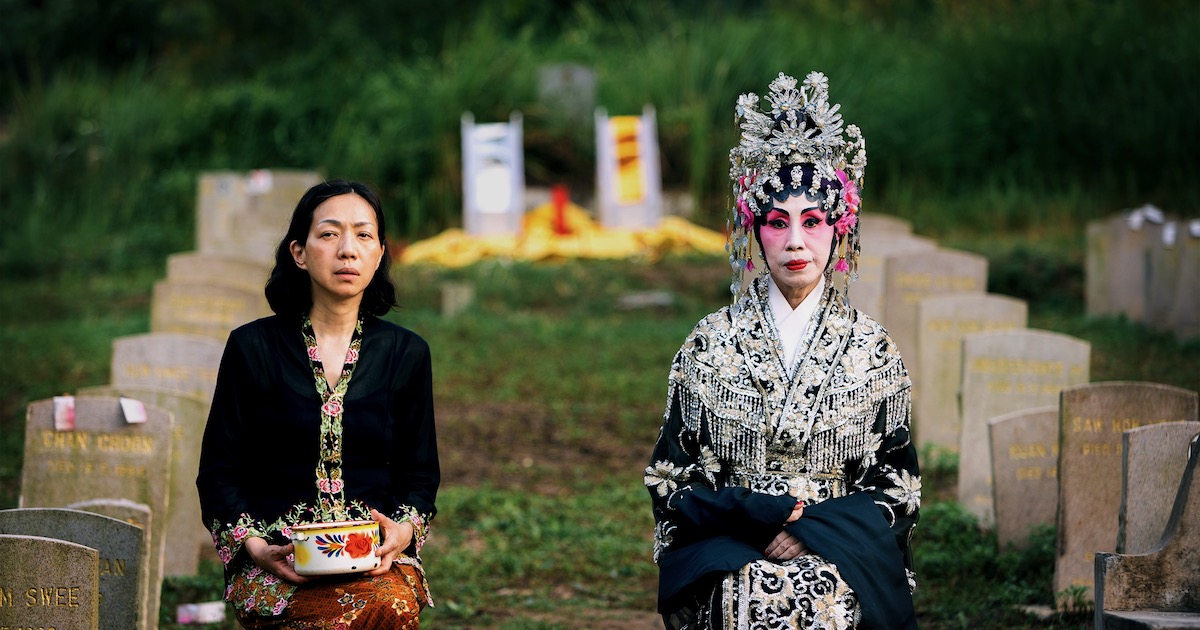
The second chapter marks a major departure, shifting from relatively fast-paced tension to a much slower, more contemplative lens. It’s a masterful shift that reflects the scars left by the riots, as the style takes over the emotions felt by the characters. Taking place 49 years after the initial events, Ah Eng’s quest to identify the graves of her loved ones intersects with Dou E’s desire for a final performance at the same cemetery. The irony is gut-wrenching when the radio serenades about “a land of peace and prosperity,” even as Ah Eng remains haunted by the violence that wiped out half of her family.
Keat Aun Chong doesn’t pander to Western audiences, but he does keep the film accessible by subtly revealing the racial fissures through the characters’ everyday experiences. The soundscape, laden with chants and songs encouraging people to vote, subtly informs the viewer about the political climate, its charged atmosphere, and its societal implications.
Chong´s directorial decisions are effective all around. The director takes a sensitive yet hard-hitting approach to depicting real-life violence. Rather than exploit the suffering with graphic displays, he focuses on the emotional and psychological impacts—widespread fires through the city, distraught faces, and a horrifying motif of dripping blood. The result is haunting, made more so by a dark set of strings playing ominous tunes during the film’s most emotionally charged scenes. In addition, to add a sense of realism, the director incorporates actual radio broadcasts from the 13th of May as part of the soundscape as all hell breaks loose, to let the viewer experience not only what the people were witnessing back then, but also what they heard.
Actresses Wan Fang (Ah Eng) and Pearlly Chua (Dou E) both turn in extremely believable, convincing performances that respectively naturally express grief, stoicism, and fear in a natural way. These emotions are so palpably etched on their faces that they elevate the film’s emotional stakes to an emotionally intense level for the majority of the film. Though Fang only plays the adult version of the character Ah Eng, her portrayal of this character captures the very essence of the girl/woman who transitions from an innocent schoolgirl to a woman still tortured by the past. Chua’s theatrical Dou E, first burdened by bureaucratic issues and societal prejudice, then in complete shock by the disaster around her, and finally grief-strucken shows a wide range of heavy emotions. The authentic performance by the actress embodies the different stages Chinese-Malaysian people have had to go through. Together, the two central performances serve as the emotional heartbeat of the film, making the pain and sorrow of the characters intensely palpable.
“Snow in Midsummer” is a skilled take on a complex, historic tragedy that’s been largely overlooked and misrepresented. The film’s two-part structure successfully guides us from the tension-filled night of May 13, 1969, to a more contemplative present-day Malaysia. Keat Aun Chong showcases his storytelling ability by balancing emotional stakes and cultural-historical elements. The director is able to tell a story that is accessible to all, without pandering to Western audiences. His sensitive treatment of real-life violence, enhanced by a haunting soundscape, sets the film apart from many others that portray violent tragedies. the performances make the emotional stakes intensely palpable, embodying the lingering grief and stoicism that ripple through the decades. All these elements make “Snow in Midsummer” both a gripping film and a critical reflection on Malaysia’s tumultuous past and its echoing impacts on the present.
“Snow in Midsummer” premiered at the 2023 Venice International Film Festival as part of the Giornate degli Autori / Venice Days sidebar.
 obviouslyreviews.com