
VENICE FILM FESTIVAL
A young woman returns to the shelter she had lived in for fourteen years, to make a confession about her experiences in the underworld. This unleashes a great media spectacle around the dark activities some prominent figures engage in. However, in this socio-political drama, nothing is quite what it seems.
Directed by: Fernando Guzzoni
Year: 2022
Country: Chile, Mexico, France, Luxembourg, Poland
Length: 99 minutes
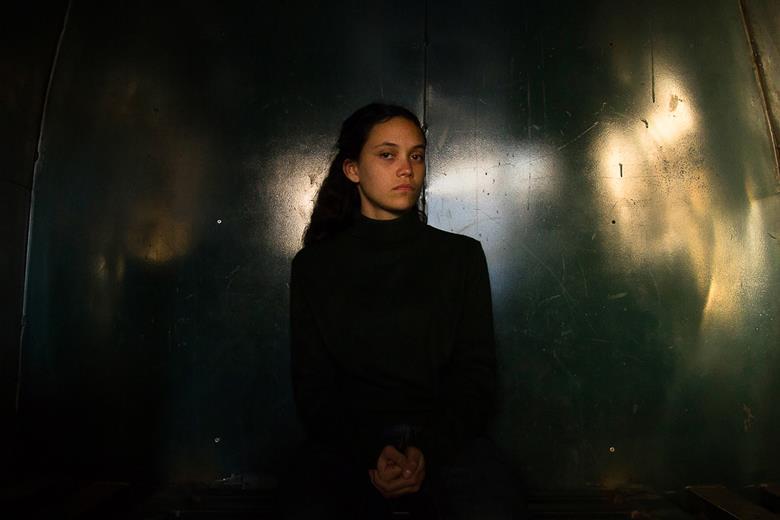
The opening scene of Blanquita introduces us to Blanca (Laura López), a young woman who’s seen sitting in a dark, isolated room. Beside her on the bed lies a baby. From outside of Blanca’s chamber, we can hear constant screams. This immediately sets the dark, cold tone for the film, but also tells us about the living conditions in our main setting, a juvenile center in Chile.
Blanca goes out to check what’s going on and finds Carlo (Ariel Grandon), another resident of the center. Carlo is a young man with a dark past full of abuse. After witnessing Carlo’s rage during a violent meltdown, Blanca is the only who’s able to calm him down. This marks the start of a friendship, in which Carlo confides in Blanca to tell her about his past, which Blanca might just use to her advantage.
Blanca’s gentle treatment of Carlo in this situation almost makes the viewer think she’s a care worker, but we soon find out that she herself has gone through a lot. Blanca, who’s now 18 years old, confesses to the people at the shelter that she has witnessed several politicians and rich men partake in sex parties involving minors. Being one of the victims herself, Blanca is pressured to constantly relive her trauma and tell her story over and over to new parties. A wide investigation is launched, with media gradually getting more interested in covering this story. But once Blanca gets asked to describe a more detailed version of her experiences, there appear to be holes in her story.
While a film about this situation could start a necessary conversation about abuse of power, the immense pressure that’s put on survivors when trying to receive justice, and the harsh treatment of impoverished, neglected youth by society, there lies some danger in highlighting this particular story. Over the past few years, we’ve seen an increasing number of sexual abuse survivors that have spoken up against their abusers, regardless of their profession and position in society. Many powerful figures have accused their accusers of lying, oftentimes resulting in large groups turning against the actual survivors. Even though Blanquita presents this case with much nuance and even makes you root for the protagonist by having you witness the bigger picture, Guzzoni leaves his film’s message up for interpretation in the end. One must find out for themselves what greater message Blanquita offers. A tighter, clearer conclusion (and possibly a final note that explains the films’ stance) could prevent specific audiences from being able to use this film, in particular the act of lying that’s presented here, as a way to attack survivors of assault.
Blanquita is inspired by a real-life mid-2000’s investigation of the ‘Spiniak Case’, a network of child prostitution, trafficking, and abuse, led by a high-profile Chilean businessman. Blanca’s character is based on one of the key witnesses in the investigation, who was found to have told an unreliable story. Blanquita delves into the reasons as to why someone would lie in a case like this, with director Fernando Guzzoni presenting a refreshing view, raising interesting questions. Could a lie about a topic like this be justified if it serves a greater good and might prevent underprivileged people from experiencing serious trauma? And is a lie still a lie if it’s rooted in someone else’s truth?
Blanquita premiered at the 2022 Venice International Film Festival in the Orrizonti competition, where it won the award for Best Screenplay.
 obviouslyreviews.com